About 45–60 minutes
Walk the street stations
Start near Al-Umariyya School, follow Stations I–IX through the market streets, and reach the Holy Sepulchre entrance.
Jerusalem · Attractions
The Via Dolorosa winds through Jerusalem's Muslim and Christian Quarters, following the traditional Christian Stations of the Cross from the area near Lion's Gate to the Church of the Holy Sepulchre. Nine stations are marked in the streets, while the last five are inside the church. Use my station-by-station guide and map to choose a starting gate, follow the turns and plan the time you need.
Updated

Location
Jerusalem's Old City
Muslim and Christian Quarters
Time needed
1–3 hours
Allow longer for prayer and church interiors
Public route
Free
Some museums and chapels have separate admission
Best visiting time
Morning
Church hours and services vary
Stations
14 traditional stops
Nine outdoors, five inside the Holy Sepulchre
Walking
Stone lanes and steps
Slopes, crowds and narrow entrances
Begin near the Lion's Gate approach and the first station at Al-Umariyya School. The traditional route leads west through the markets to the Church of the Holy Sepulchre. Its street stations are indicated by signs and Roman numerals.
The traditional walk covers about 600 metres through winding, sometimes steep Old City lanes. Look for the numbered station markers along the way.
About 45–60 minutes
Start near Al-Umariyya School, follow Stations I–IX through the market streets, and reach the Holy Sepulchre entrance.
About 1.5–2 hours
Follow the outside stations and continue into Calvary and the Holy Sepulchre, allowing time for brief pauses and the tomb shrine.
2.5–3 hours or more
Include the Flagellation chapels, Ecce Homo, archaeological remains and a longer visit to the Holy Sepulchre.
Blue pins mark the nine outdoor stations. The gold pin marks the Church of the Holy Sepulchre, home to Stations X–XIV.
Enable External content in Cookie settings to view the map.
Select a station
The locations follow the traditional devotional route. The last five stations are inside the Holy Sepulchre.
| No. | Traditional event | Where to look |
|---|---|---|
| 1 | Jesus is condemned to death | Al-Umariyya School courtyard (traditional starting area)Access to the school courtyard depends on arrangements; begin at the street outside. |
| 2 | Jesus takes up the cross | Franciscan Chapel of the Condemnation & Church of the FlagellationOpposite the first station; both are within the Franciscan compound. |
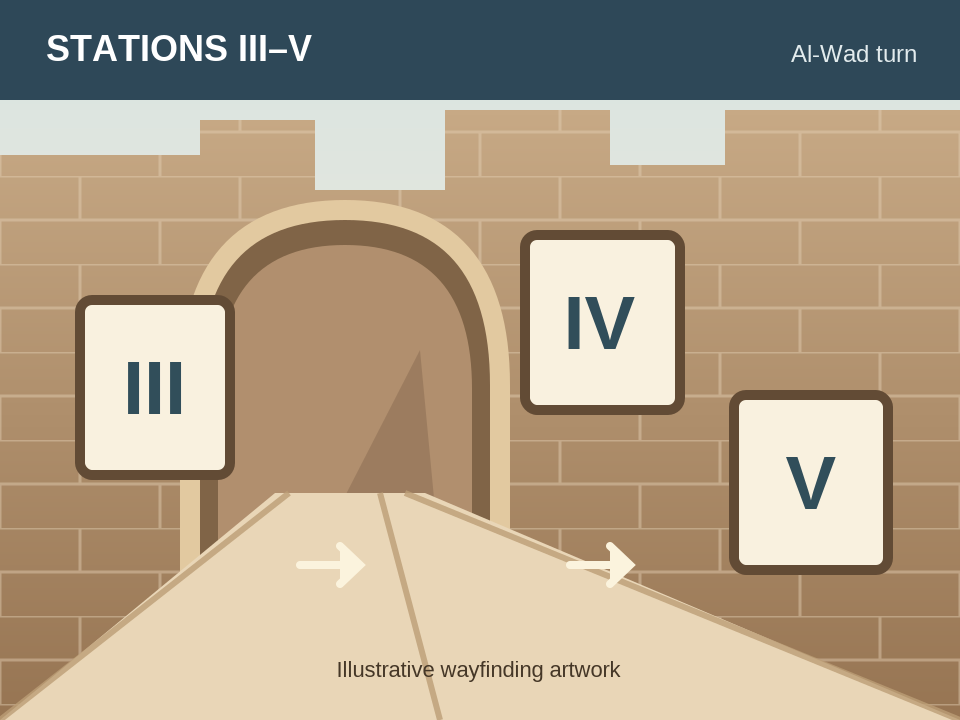
| 3 | Jesus falls for the first time | Via Dolorosa / Al-Wad (El-Wad) junctionLook for the Polish Catholic chapel near the turn south. |
| 4 | Jesus meets his mother Mary | Armenian Catholic Church of Our Lady of SorrowsA few steps south of Station III; marked by a relief over the doorway. |
| 5 | Simon of Cyrene helps carry the cross | Al-Wad street corner and westward turnLook for the Franciscan oratory at the bend. |
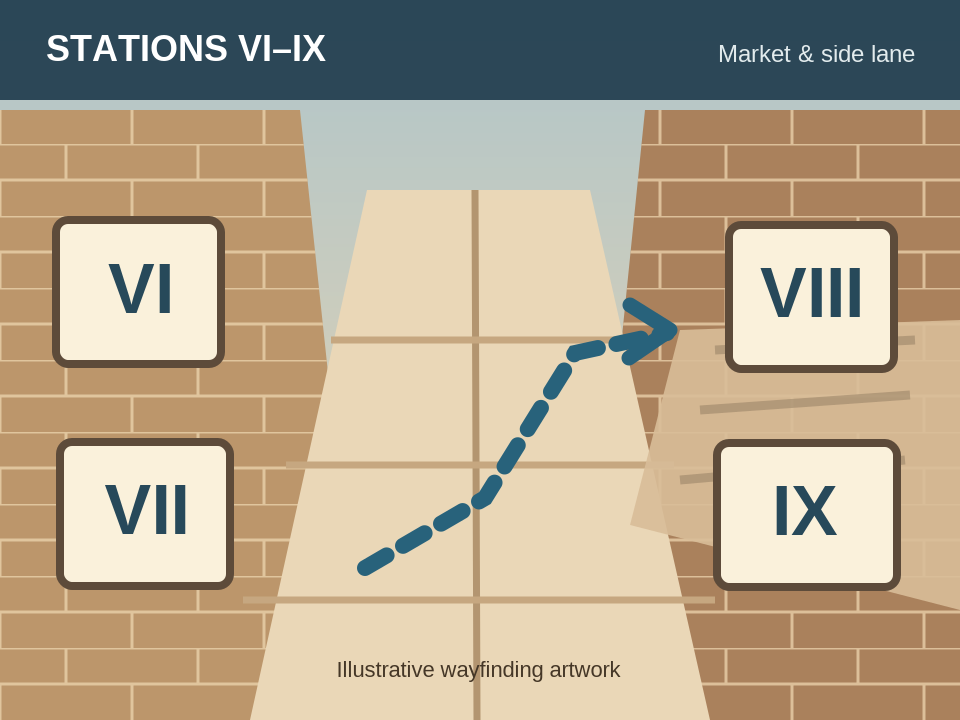
| 6 | Veronica wipes Jesus' face | Westward Via Dolorosa market laneTraditional site near a wall marker and the chapel associated with Veronica. |
| 7 | Jesus falls for the second time | Via Dolorosa / Khan al-Zeit market crossingWatch for the chapel at the busy junction. |
| 8 | Jesus addresses the women of Jerusalem | Al-Khanqa (Khanqa as-Salahiyya) laneThe station is marked on a wall near the Greek monastery. |
| 9 | Jesus falls for the third time | Coptic Orthodox monastery approachTake a short detour toward the Coptic monastery and Deir al-Sultan above the church. |
| 10 | Jesus is stripped of his garments | Church of the Holy Sepulchre — Calvary areaThe last five stations are commemorated inside the church. |
| 11 | Jesus is nailed to the cross | Holy Sepulchre — CalvaryWithin the elevated Calvary chapels. |
| 12 | Jesus dies on the cross | Holy Sepulchre — CalvaryThe main Calvary altar is a major prayer site. |
| 13 | Jesus is taken down from the cross | Holy Sepulchre — Latin altar of Our Lady of Sorrows, on CalvaryStation XIII is at the altar between the crucifixion chapels. The Stone of Anointing, downstairs, commemorates preparing Jesus' body for burial. |
| 14 | Jesus is laid in the tomb | Holy Sepulchre — EdiculeExpect a queue to enter the tomb shrine. |
Open each Google Maps leg in order. The final leg visits Station VIII, returns to the Station VII market junction, then follows the steps toward Station IX by the Coptic monastery before continuing to the Holy Sepulchre. Follow the numbered wall markers at each junction.
For arrival and departure, use Lion's Gate directions and Holy Sepulchre to Jaffa Gate.
The walk traditionally begins at the former Antonia area near Al-Umariyya School, where Station I recalls Jesus being condemned to death. The school is in use; pilgrims generally start at the street outside, depending on local access.
Across the street, the Franciscan compound contains the Chapel of the Condemnation and the Church of the Flagellation associated with Station II. Look for the numbered mark on the exterior wall.
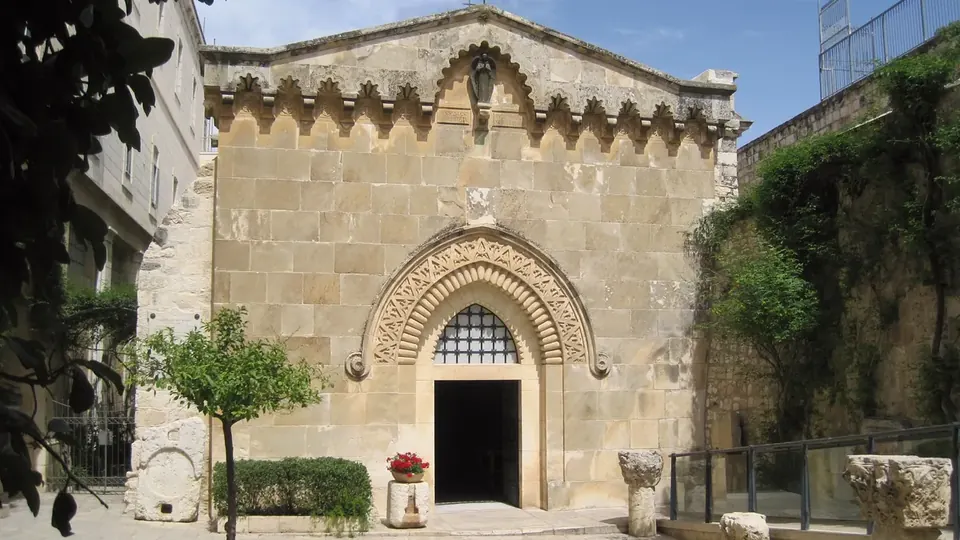
Continue past the historic Ecce Homo Arch. The Sisters of Notre Dame de Sion maintain the nearby Ecce Homo Basilica and the ancient pavement known as the Lithostrotos. These remains offer a glimpse of Jerusalem during the Roman period.
The arch and pavement acquired their Christian associations over time.
Check Ecce Homo opening hours before planning an interior visit.
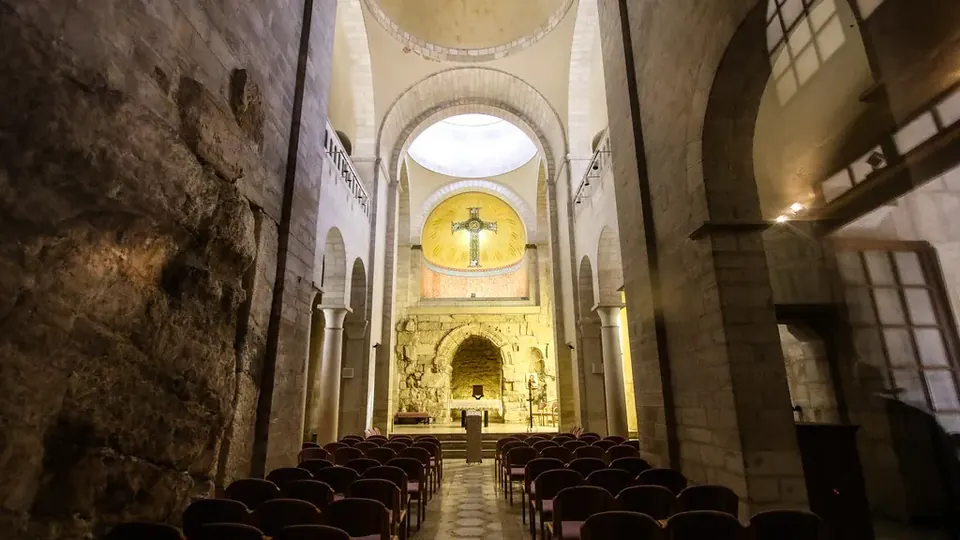
At the junction of Via Dolorosa and Al-Wad Street, Station III marks the traditional first fall. A Polish Catholic chapel stands nearby. A few steps farther south, Station IV recalls Jesus meeting Mary at the Armenian Catholic Church of Our Lady of Sorrows.
At Station V, beside the turn back toward the west, a Franciscan oratory commemorates Simon of Cyrene carrying the cross. Watch for the Roman-numeral markers at each doorway and corner.
Follow the westward lane past the traditional place where Veronica wiped Jesus' face (VI). At the Khan al-Zeit market junction, Station VII recalls the second fall. Station VIII is marked on a wall along the Al-Khanqa lane, commemorating Jesus speaking to the women of Jerusalem.
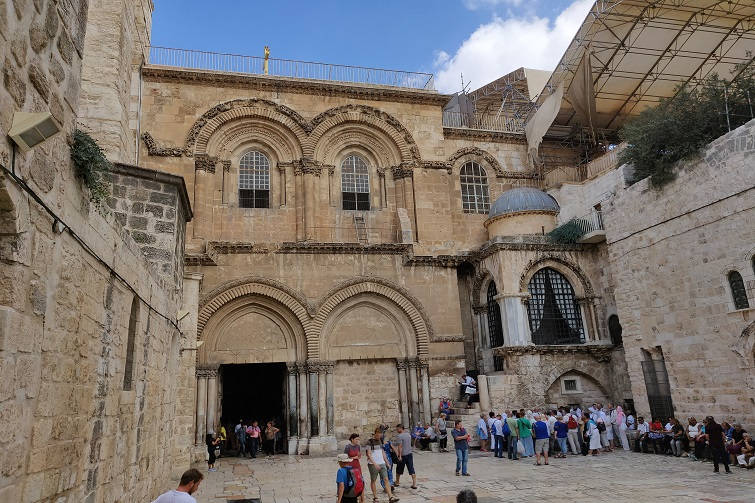
Station IX is near the Coptic Orthodox monastery above the Church of the Holy Sepulchre. A short detour from the market street leads to this station. From there, continue toward the church entrance.
The final five stations are commemorated inside the church: Jesus being stripped of his garments (X), nailed to the cross (XI), dying on the cross (XII), taken down from the cross (XIII), and laid in the tomb (XIV).
At Calvary, visitors climb to the elevated chapels associated with the crucifixion. Station XIII is marked by the Latin altar of Our Lady of Sorrows, between the preceding stations. The nearby Stone of Anointing, downstairs, recalls preparation for burial, and the Edicule encloses the traditional tomb. Allow additional time for worship and queues.

You can follow the outdoor Stations of the Cross for free. Churches, chapels and museums along the route have their own visiting hours.
| Site | Published visiting hours | Admission | Information |
|---|---|---|---|
| Via Dolorosa streets | Public walking route throughout the day | Free | Look for station markers and shopfronts along the way |
| Church of the Flagellation | 07:00–18:00 summer / until 17:00 winter | Check at church | Current sanctuary hours |
| Ecce Homo Basilica & Lithostrotos | 08:00–17:00 | Confirm at entrance | CIC visiting information |
| Terra Sancta Museum | Tue–Sun 09:00–18:00 summer / 09:00–17:00 winter; Mon 14:00–18:00 summer / 14:00–17:00 winter. Last admission 30 minutes before closing. | ₪30 Via Dolorosa Experience; ₪40 museum tour; ₪50 combined ticket (standard admission) | Official hours and tickets |
| Church of the Holy Sepulchre | Open daily, with seasonal opening times and religious services | General entry free | Check current church hours |
The Franciscans regularly lead a Friday devotional procession along the Via Dolorosa, beginning at the Church of the Flagellation. The Christian Information Center's published schedule lists 16:00 in summer and 15:00 in winter. Confirm arrangements for your date, especially during Holy Week and major religious observances.
Underfoot: Expect uneven or polished stone paving, steps, sloping lanes and busy market intersections. Use comfortable shoes and allow time for pauses.
Wheelchairs and strollers: Some streets are easier to navigate with a wheelchair or stroller. Narrow chapel entrances and steps near Station IX and Calvary can make wheelchair access difficult.
With children: Choose a shorter route focusing on the major visible stations and the church exterior, with breaks in the Christian Quarter.
Prayer spaces: Respect services and posted photography instructions. Groups wishing to arrange private prayer or religious services should contact the relevant church in advance.
My Old City guide explains entrance gates, accessible approaches and nearby facilities.
Begin near the eastern end of Via Dolorosa by Lion's Gate and the Flagellation church. Damascus Gate also offers an approach through the Muslim Quarter markets. If you're arriving by taxi or private transfer, arrange to be dropped off near the most convenient Old City gate.
From Lion's Gate, walk west toward the Flagellation church and Station I. From Damascus Gate, walk through the market lanes toward the eastern Via Dolorosa.
Jerusalem's light rail serves the northern approaches near Damascus Gate. Use the journey planner to choose your station and continue on foot.
Arrange a drop-off near Lion's Gate or another suitable road approach. For a visit ending near the Holy Sepulchre, plan pickup near Jaffa Gate or New Gate; contact me with your dates and hotel.
Via Dolorosa means the “Sorrowful Way.” The traditional fourteen Stations of the Cross commemorate episodes in the Christian accounts and devotional retellings of Jesus' path to crucifixion, death and burial.
Christian pilgrims have followed changing routes across Jerusalem for many centuries. Franciscan devotion helped establish the station tradition, while the familiar itinerary and its markers developed gradually through medieval and later periods. Today's streets and buildings date from different periods in Jerusalem's history.
The Via Dolorosa is a route of Christian devotion. Today's streets cannot establish the exact path Jesus took in the first century or the location of Pilate's judgment. The Franciscan Terra Sancta Museum station guide explains the history and associated chapels in detail.
The Jerusalem churches guide places the Via Dolorosa beside other Christian sites across the city, while my Old City visitor guide covers the surrounding quarters and markets.
These guided Jerusalem walks cover Old City heritage and sections of the Via Dolorosa. Check each operator's exact Stations of the Cross itinerary, meeting point and available dates before choosing.

Booking platform: Viator
Explore the Old City's religious landmarks, historic lanes and markets on a focused guided walk.
Booking platform: Viator
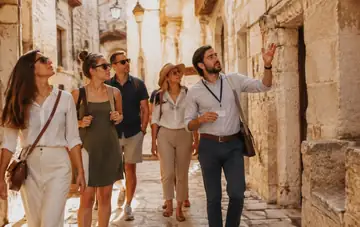
Walk through Old City quarters and landmark sites with a guide dedicated to your group.
Booking platform: Viator
A longer guided Jerusalem day combining the Mount of Olives with historic and religious sites inside the Old City.
Browse additional Jerusalem guided walks. For transport to and from the Old City, I can help with a private driver.
The traditional starting point is near Al-Umariyya School and the Church of the Flagellation close to Lion's Gate. The route ends at the Church of the Holy Sepulchre in the Christian Quarter.
Fourteen traditional stations: nine along the streets of the Old City and the final five inside the Church of the Holy Sepulchre.
Allow about 45–60 minutes for the outdoor route, 1.5–2 hours with brief visits to the final five stations, or more time for chapels, exhibitions and prayer.
Walking the public street stations and entering the Holy Sepulchre is generally free. Some museums, exhibitions and associated facilities charge separately.
The Christian Information Center currently publishes a regular Franciscan procession at 16:00 in summer and 15:00 in winter, beginning at the Church of the Flagellation. Confirm local arrangements on the intended day.
Lion's Gate is a convenient approach to the early stations. Damascus Gate offers access through the Muslim Quarter; Jaffa Gate or New Gate work well when finishing near the Holy Sepulchre.
Some sections can be reached by wheelchair or stroller, but expect steps, slopes, narrow entrances and crowded lanes. Check suitable routes to individual stations and accessible entrances to the Holy Sepulchre before your visit.
 Jerusalem's Old CitySee the city gates, four quarters and major landmarks around the walk.
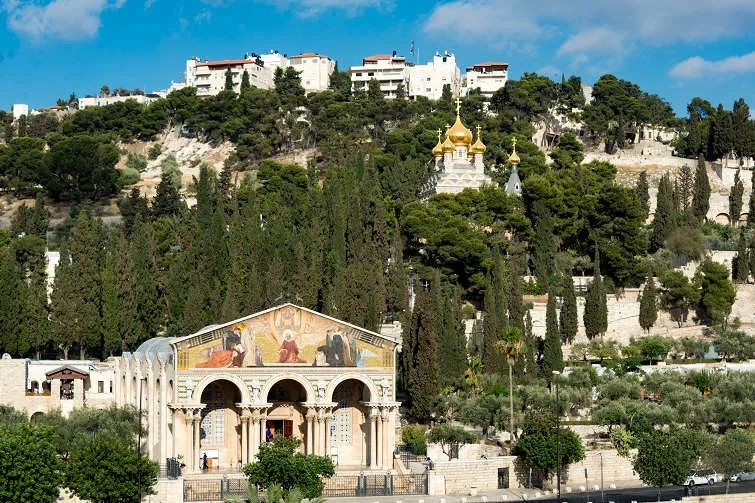 Mount of OlivesVisit Gethsemane and the traditional pilgrimage sites east of the walls.
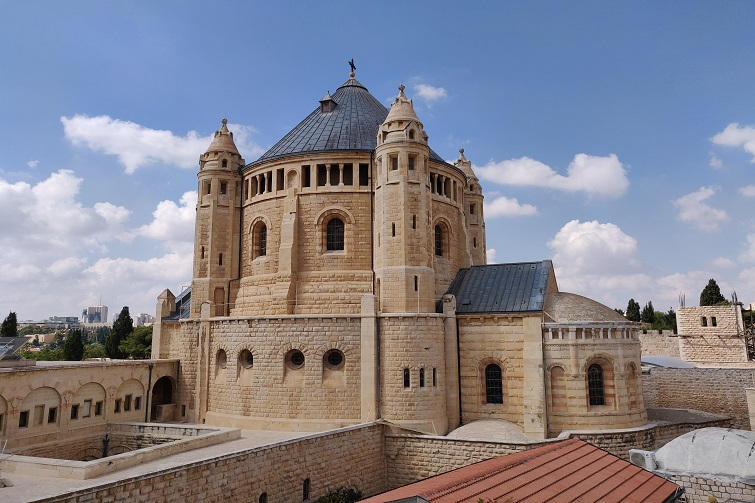 Mount ZionExplore the Last Supper tradition and churches south of the Old City.
 Churches in JerusalemFind other Christian sites, opening hours and nearby churches.
 Jerusalem travel guidePlan your city stay and wider Jerusalem sightseeing.
 Museums in JerusalemExplore the history, art and archaeology of Jerusalem.
Contact me
Tell me your Jerusalem pickup point, travel date, passengers and whether you want to combine the Via Dolorosa with other Old City landmarks. I can arrange private transport with a driver to a suitable gate and pickup after your walk.
Official information checked November 2026.